Mapping the neural
architecture of
consciousness
Mission
AWARENET aims to build an integrated atlas of consciousness, combining fine-grained intracranial data with large-scale brain organization to explain how awareness emerges and how it can be disrupted by brain lesions.
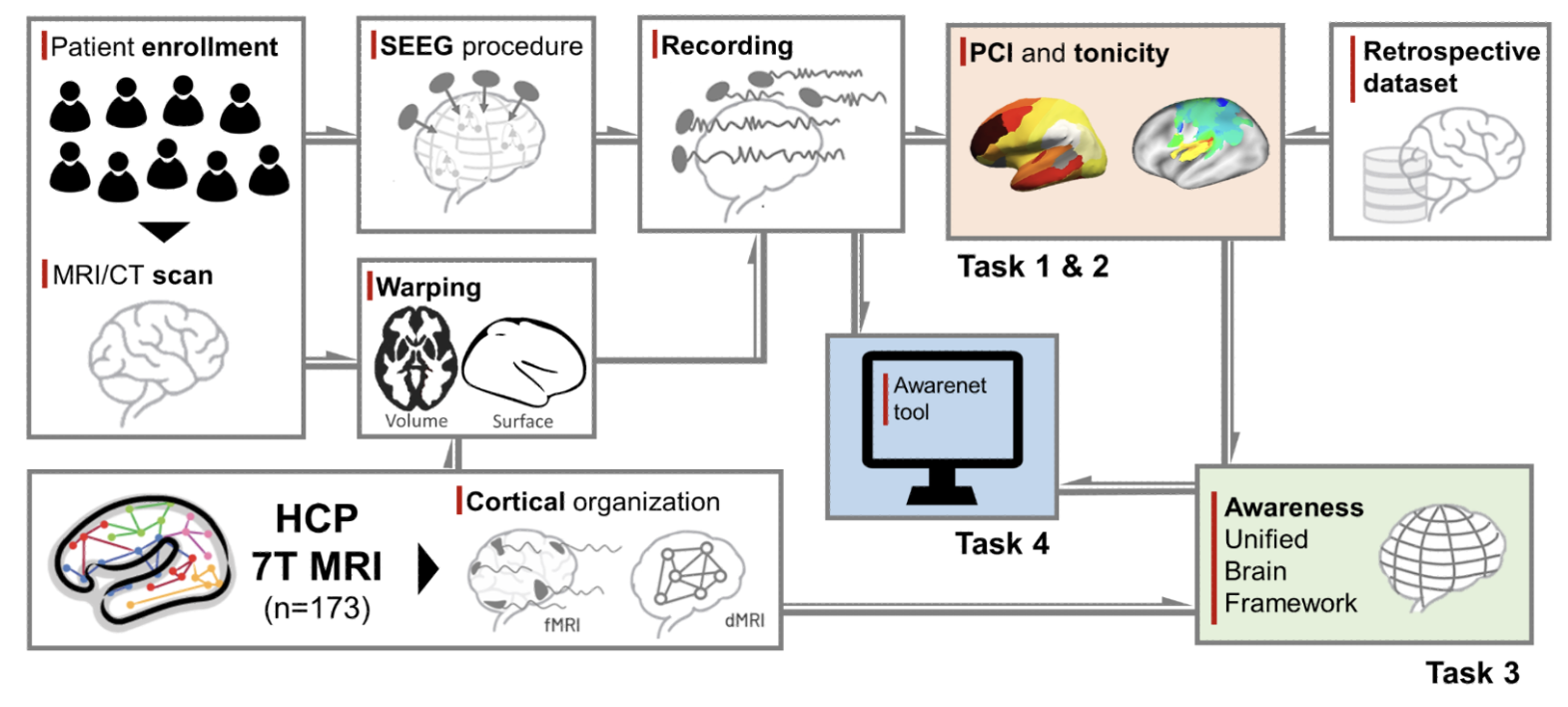
Using stereo-EEG recordings and stimulations in humans, AWARENET links the level of consciousness (how awake or responsive the brain is) and the content of consciousness (what we perceive) within a common spatial framework.
This unified Awareness Atlas serves both fundamental science and clinical practice, supporting diagnosis and rehabilitation in conditions such as stroke, epilepsy, coma, and vegetative state.
Main challenges
- No direct fMRI: Intracranial recordings (sEEG) provide high precision but lack functional connectivity data.
- Multi-scale integration: Bridging local neural dynamics (PCI, tonicity) with large-scale cortical organization requires advanced modeling and alignment techniques.
- Causality and translation: Testing how focal lesions alter consciousness, and extending this knowledge to clinical tools, remains a key conceptual and methodological goal.
What we aim to do
Map consciousness networks
Use intracranial perturbations and recordings (sEEG) to identify brain regions supporting the level and content of consciousness.
Integrate key measures
Combine PCI, Tonicity, and Functional Gradients into a unified Awareness Atlas describing how consciousness is distributed across the cortex.
Align with normative connectomes
Embed intracranial data within large-scale fMRI/dMRI gradients (HCP 7T) to link local neural dynamics with whole-brain connectivity.
Model lesion disconnections
Integrate structural and functional information to reconstruct connectivity loss where no direct fMRI data are available.
Test causal mechanisms
Study patients undergoing controlled thermocoagulation lesions to relate behavioral decline to disconnection patterns in the atlas.
Develop predictive tools
Build models that estimate how brain lesions alter awareness, providing interpretable and clinically relevant predictions.
Deliver the Awareness Unified Brain Atlas
Create a computational framework connecting intracranial physiology, brain networks, and clinical outcomes in a single reference space.
Workflow